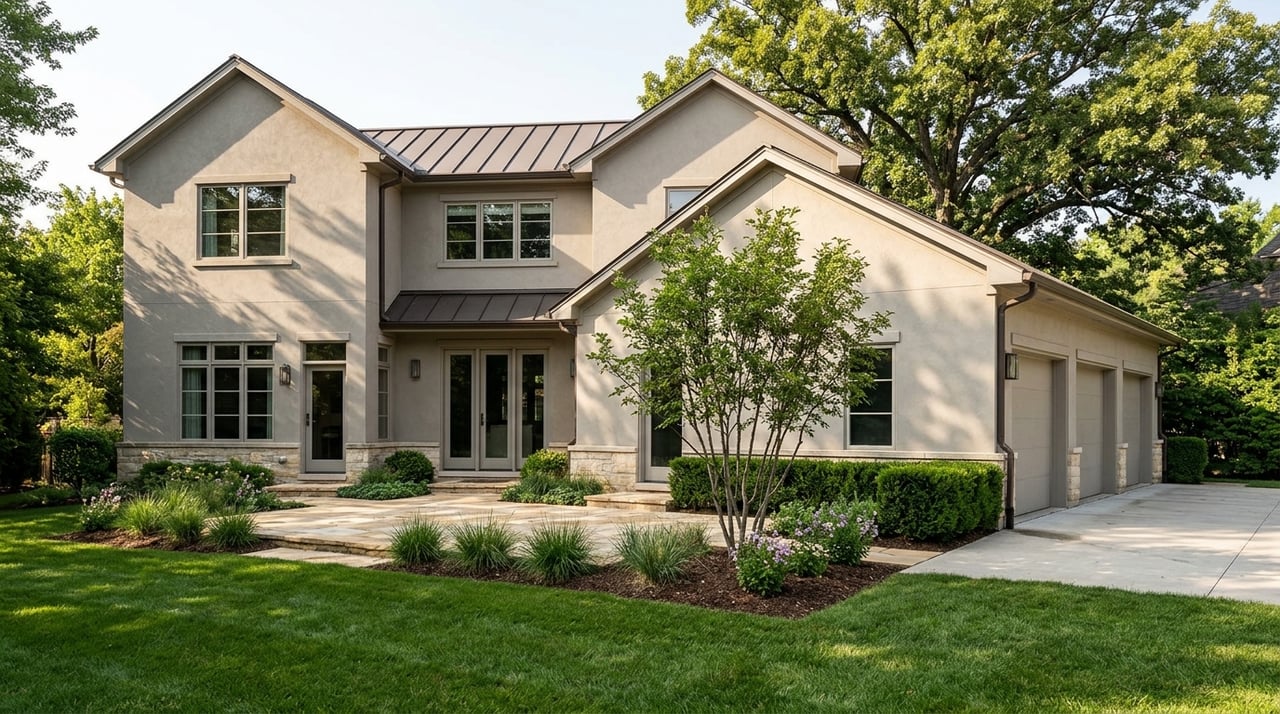
A buyer touring two homes in Lone Tree this summer will often see the same story twice: nearly identical square footage, nearly identical asking price, and a property tax estimate on the listing sheet that looks close enough to call a wash. Then the title commitment arrives, and one of those homes turns out to cost $1,200 to $2,800 more per year than the other while the district's bonds remain outstanding. The gap has nothing to do with school ratings or lot size. It comes down to a boundary line most buyers never think to ask about until it is already baked into their monthly payment.
That boundary is a metropolitan district, and in Lone Tree, especially inside RidgeGate, it is the single biggest reason two comparable homes carry two very different carrying costs.
The tax figure in the listing is a historical number, not a forward estimate
Every Colorado MLS listing shows a property tax line pulled from the county's most recent bill. On an older resale home, that number is usually a fair proxy for what a new owner will pay. On newer construction inside a metro district, it can understate the real cost significantly, because the district's mill levy is layered on after the county figure is set, and lenders, portals, and even automated valuation tools tend to treat the listed number as gospel anyway.
The City of Lone Tree is direct about what these districts are and are not. A metropolitan district is a special taxing district under Colorado's Title 32, created to finance and manage public infrastructure inside its own boundary, similar in legal structure to a school or fire district. It is funded through property tax, not membership dues, and it can issue tax-exempt bonds to build roads, water lines, and drainage before a single house is finished. That is the mechanical difference between a metro district and a homeowners association: an HOA is a private group funded by dues that governs covenants and shared landscaping, while a metro district is a government entity funded by a mill levy that repays construction debt. Lone Tree's own guidance is explicit that the city itself does not collect or administer these district taxes. They exist alongside the city's tax structure, not inside it.
What the stacking actually costs on a real number
Run the math on a $900,000 Lone Tree home using Colorado's 2026 residential assessment rate of 6.765 percent. That produces an assessed value of roughly $60,885. Apply Douglas County's base mill levy, which runs around 85 mills across much of the southern metro, and the county-level property tax lands near $5,175 a year, before any district assessment is added.
Now add a RidgeGate metropolitan district assessment on top of that same home. Reporting on Lone Tree's transit-oriented development has put that additional CDD-style charge at roughly $1,200 to $2,800 a year, depending on which sub-district the parcel sits inside. Stack that onto the base county tax and the same $900,000 home can carry a real annual load of $6,375 to $7,975, before HOA dues or insurance enter the picture at all.
| Cost layer | Applies to every Lone Tree home | RidgeGate-specific |
|---|---|---|
| County and school mill levy (approx. 85 mills) | Yes | Yes |
| RidgeGate metro district assessment | No | Yes, roughly $1,200–$2,800/year |
| HOA dues | Varies by neighborhood | Often layered on top of the above |
That is not a rounding error. It is a difference that changes a monthly payment by $100 to $230, month after month, for as long as the district's bonds are outstanding.
For context, Douglas County-wide data on Lone Tree's 80124 ZIP code puts the median effective property tax rate at 0.60 percent, with a median annual bill around $5,152. That figure is a useful baseline, and it is also exactly the kind of number that hides the RidgeGate stacking effect, because a median blends homes inside a district with homes that sit entirely outside one.
Why two homes a half mile apart can land on opposite sides of the line
The part that catches buyers off guard is not the size of the fee. It is how narrow the boundary can be. Lone Tree contains multiple overlapping metro district footprints, and a property a half mile from a RidgeGate parcel can carry no metro district assessment at all, while a home closer to the light rail corridor sits squarely inside one. There is no visual cue on a curb or a fence line that tells you which side you are on. The only way to know for certain is to pull the actual district boundary map or request the district certificate through the title company.
This is not unique to RidgeGate. Heritage Hills, another Lone Tree community, runs on the same two-layer structure: a metro district that handles infrastructure funding through property tax, and a separate HOA that handles covenant enforcement and design review but does not maintain or operate any of the physical infrastructure itself. Two governing bodies, two different funding mechanisms, one address. A buyer who only reads the HOA documents has read half the story.
The disclosure law helps, but only if you ask for the right document at the right time
According to Mile High Title Guy, Colorado closed part of this information gap with a disclosure requirement that took effect for sales closing on or after January 1, 2024: if a property sits inside a metropolitan district organized on or after January 1, 2000, the seller has to provide the buyer with the district's official website before closing. That is a meaningful improvement over the years when a buyer might not learn a district existed until the first tax bill arrived in January.
The requirement solves the disclosure problem. It does not solve the timing problem. Title companies pull a metro district certificate as a separate document from the standard HOA paperwork, and that pull can add five to ten business days to due diligence if it is not requested on day one of the contract. On a standard Colorado due diligence window, that is not a rounding error either. A buyer who waits until week two to ask the question can find themselves negotiating an extension just to get the answer they needed before making an offer in the first place.
The practical fix is simple and something any buyer can ask their agent or title company to do immediately at contract: request the metro district certificate the same day you request the HOA documents, and ask two specific questions rather than one general one. First, what is the district's current total mill levy. Second, what is the maximum debt mill levy the district is authorized to impose. The current number tells you what you would pay this year. The authorized maximum tells you how much room the district has to raise that number later without a new vote.
How Lone Tree compares once you model all three layers
Buyers cross-shopping Lone Tree against nearby Douglas County towns need to run this same math everywhere, not just here. Castle Pines Village tends to command a premium of $100,000 to $200,000 over comparable square footage in Lone Tree, trading a metro district structure for a private club-style HOA and a different amenity profile. Parker's newer developments often land at similar price points to RidgeGate but without the same direct light rail connectivity that Lone Tree's Lincoln Station provides. Highlands Ranch can offer near-identical pricing with lower metro district fees in some pockets; Lone Tree, by contrast, has employment anchors including the Charles Schwab campus.
None of those trade-offs is automatically better or worse. They are different bets on where your money goes: into a mill levy that funds roads and parks you use daily, into HOA dues that fund a private amenity package, or into a base tax rate with fewer layers but fewer amenities attached. The only mistake is comparing two Lone Tree listings, or two Douglas County listings, on sale price alone and assuming the tax line on the MLS sheet tells the whole story.
A few questions buyers ask us directly
Does every home in Lone Tree carry a metro district fee? No. Coverage depends on which specific parcel and sub-district a property sits inside, and boundaries can change within a few blocks. A district boundary map or a district certificate pulled by title can confirm it; do not rely on a general assumption based on the neighborhood name.
Do metro district fees ever go away? They can, once the bonds that funded the original infrastructure are paid off, but that timeline is set by the district's own debt schedule and is not something a buyer can negotiate at closing.
Is a metro district fee the same as an HOA fee? No. An HOA is a private association funded by dues that typically handles covenants and shared landscaping. A metro district is a government special district funded through property tax that can fund and finance roads, water, and drainage infrastructure. Some Lone Tree neighborhoods, including Heritage Hills, have both layered on the same address.
How early should I ask about this? The same day you go under contract. Request the metro district certificate alongside the HOA documents so the five to ten business day pull does not eat into your due diligence window later.
If you are comparing homes in Lone Tree, RidgeGate, or anywhere else in Douglas County and want the real annual number before you write an offer, not after, The Colorado Agents can walk the district certificate and the full tax picture with you before you fall in love with a listing sheet that only tells half the story. Get in touch and let's run the numbers on your shortlist.
This article is general information, not legal, tax or financial advice. Consult a qualified professional about your situation.